
Keeping Locks Working in Salt Air
Close to the ocean, a lock that nobody touches still ages. Damp nights put salt on it, dry winds put dust on the salt, and the key grinds both in. A few minutes a season keeps it turning.
Plan the Year for Your Doors
Tick the doors you have. The planner lists what to do in each season.
The plan for the year will show here.
Tasks, and How Often They Come Round
| Task | Applies to | How often | Notes |
|---|---|---|---|
| Wipe salt and dust off the face of the lock | Every outside lock | Monthly | A damp cloth, then a dry one. No polish near the keyway. |
| Blow out and dry-lubricate the keyway | Cylinders, knobs, levers | Twice a year | One short puff. Work the key, wipe it, work it again. |
| Lubricate the latch and bolt | Doors that close by themselves | Twice a year | On the sliding face, not in the keyhole. |
| Tighten hinge and strike screws | Wooden doors and frames | Yearly | A screw that spins needs a longer one, not a harder turn. |
| Check how the bolt meets the strike | Deadbolts | Yearly | Lipstick or chalk on the bolt shows where it touches. |
| Clean tracks and rollers | Sliding doors | Every few months | Grit in the track lifts the panel off its latch. |
| Change keypad batteries | Electronic locks | Yearly | Before they fail. Test the mechanical key the same day. |
| Retire worn copies | Every key on the ring | When the cuts look rounded | Recut from the original, not from the copy. |
How to Clean and Lubricate a Lock
- Open the door, and throw and pull back the bolt by hand so you know how it feels now.
- Wipe the face, the bolt and the edge of the door with a damp cloth. Dry them.
- Blow into the keyway with canned air, holding the straw a finger’s width away.
- Give one short puff of dry lubricant, PTFE or graphite. Choose one and stay with it.
- Slide the key in and out ten times without turning, wiping it as you go. The marks on the cloth are what was in the lock.
- Turn the key both ways, then try it with the door shut.
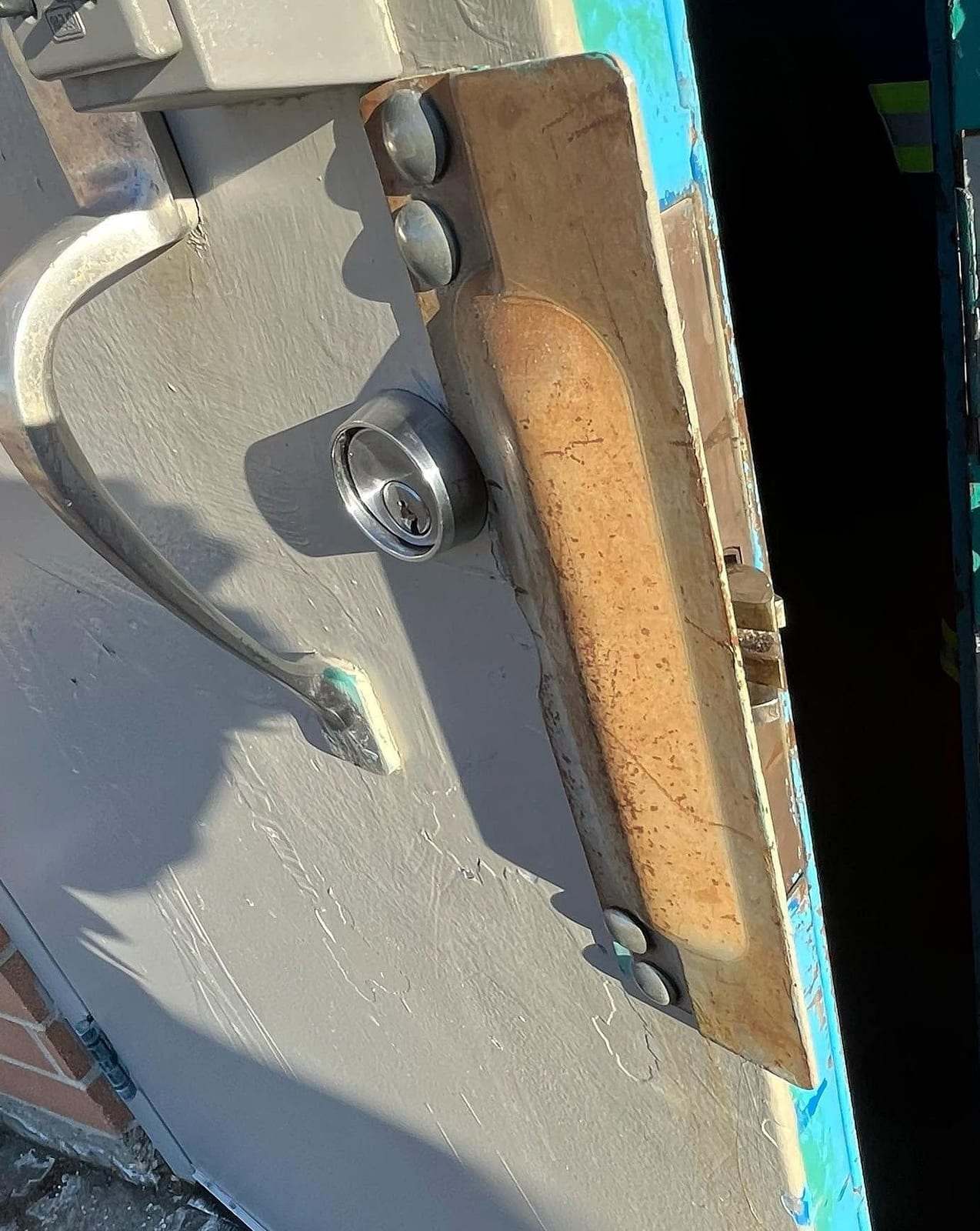
On a weathered back door there is more to look at than the keyhole. Paint creeps under plates and lifts them, rust runs from a guard’s rivets, and the cylinder may be the newest thing on the door. If the plate is loose, the lock behind it is being worked sideways with every turn.
Seasonal Lock Inspection
The damp months are when doors swell and cylinders gather salt. The warm, dry winds of fall bring the dust. Going round twice a year, once on each side of that, catches nearly everything.
- Every key turns with two fingers.
- Every bolt throws all the way and does not need the door lifted.
- No screw is missing from a strike, a hinge or a handle.
- Latches click shut by themselves when the door is let go.
- Finishes are dull at worst, with no blisters or green crust.
- The spare key has been tried within the last year.
Questions About Salt, Rust and Lubricant
Why do locks near the beach go stiff?
Salt arrives in the air and settles on cold metal overnight. It draws water, the water carries it into the cylinder, and what dries there is a fine grit. Brass turns dull and green, springs and screws made of plain steel rust, and plated zinc lifts in blisters.
Is stainless hardware worth it here?
On an exposed door, usually. Solid brass and marine-grade stainless last longest outdoors. Plated finishes do well under a porch roof and poorly on a gate that faces the wind.
Can I use the blue can from the garage?
It will free a stuck hinge and wash out the last good lubricant with it. In a lock it leaves a film that holds dust. Keep it for hinges and use a dry product in the cylinder.
How much lubricant is enough?
Less than it looks. If any runs out of the keyway, that was too much; wipe it up and work the key until it comes out clean.
When has corrosion gone too far?
When the key feels gritty straight after a cleaning, when a screw head crumbles, or when the plug has play in it. At that point the cylinder is worn inside, and cleaning only buys a little time.
Already sticking? The Key Won’t Turn Guide starts from the symptom instead.
If it still feels gritty after a cleaning, the wear is inside. We can look at the cylinder.